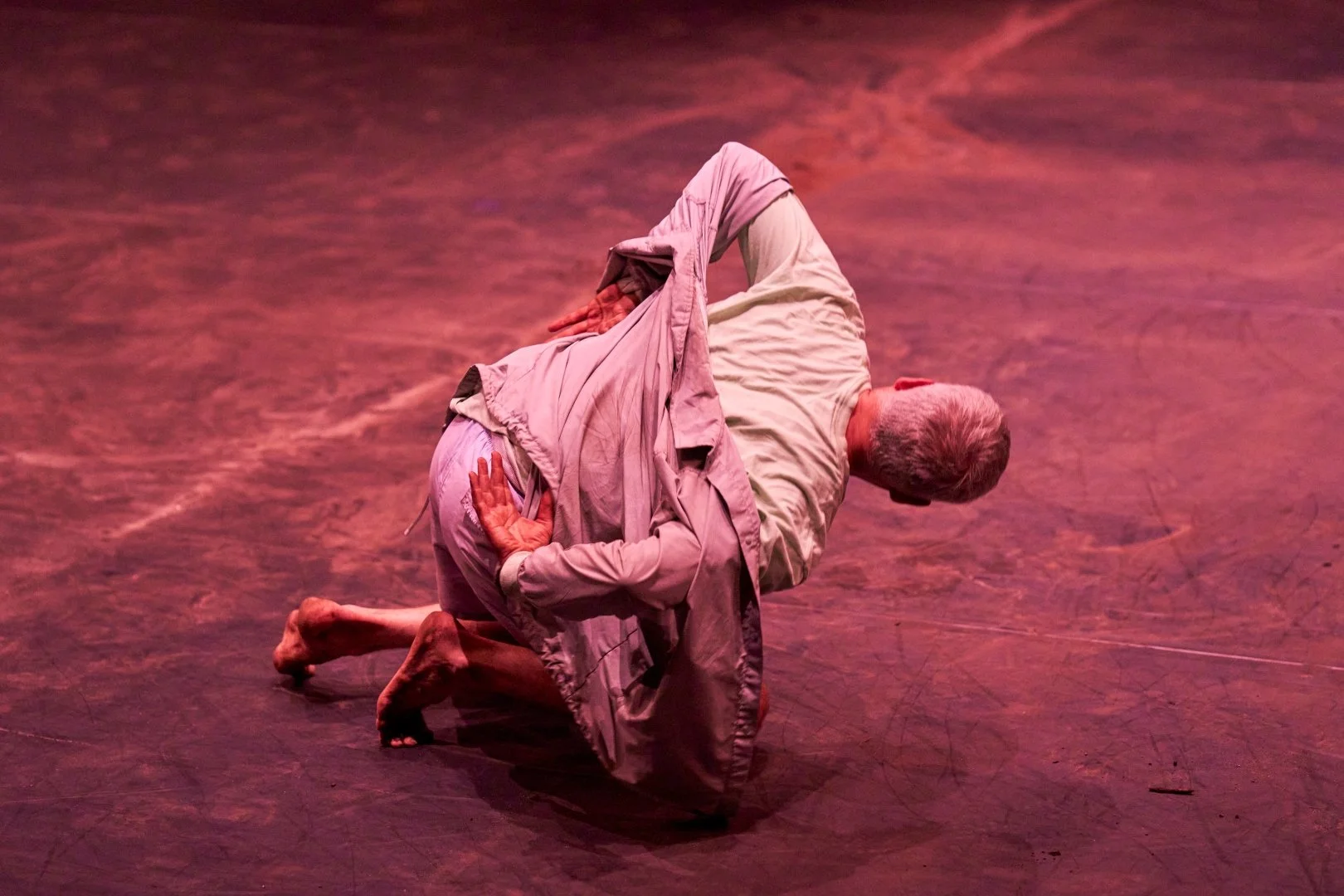
Photo: Pierre Tran
I had a cousin who was a biologist, and from time to time she would write to tell me about the significance of lichen compounds. At first, I had no clear idea what a lichen was, but soon I began to appreciate its complex ecosystem, composed of a symbiotic relationship among fungi, algae, and non-photosynthetic bacteria. It's a mouthful, I know. But what was thrilling, at least to me, was how these organisms, adapting to new environments, develop defence mechanisms against predators. Or something like that.
Entering Tangente the other night, I encountered a work, The Choreographic Garden – Vegetal Transformation, largely inspired by these compounds and offering a warm, cozy habitat. Never did I honestly expect to encounter a physical manifestation of that extraordinary chemistry embodied in a choreographic work. It profoundly moved me. Somewhere during the piece, choreographer Hanna Sybille Müller informed the crowd that lichen are recognized as sources of traditional medicines. All true. What she didn't say was that some lichens are used as external disinfectants for dressing wounds or stopping bleeding, for skin infections and sores, lung and digestive ailments, and obstetrical ailments. I expect that would have been too gross for most in the audience, as it may be for some who are reading this column.
On stage, according to the press materials, 700 kilos of soil contained in industrial bulk bags create the environment in which the performers invest their essence, enacting cycles of cellular stress and regeneration. Müller and her top-notch performers, Diego Gil, Natte Yaffe, Lauren Semeschuk, and onstage sound designer Damaris Baker, delve into mutualistic organic relationships, enlivening the stage with an abundance of intertwined movement. Bodies bundled together push against one another, heads under crotches, rolling back and forth, strings attached to mouths like fish on a lure. Like lichen, they appear as irregular patches reminiscent of mold or fungus, forms brought from some evolutionary past but reverted from a previous lichenized state. Their gestural vocabulary often resists classification. Yes, the performers stand out with different textures in their restless movement and shifting intonations of voice, but at other times they appear simply to blend into the substrate on which they grow. Notably, lichens live on other organisms, living or dead, from which they draw nutrients, and Müller and her group investigate those capacities to the fullest.
Baker is instrumental in giving texture to this Garden, using small natural objects such as dried seedpods, wood, a wavering metal strip, and bells, composing subtle atmospheric soundscapes. Spurts and burbles of sound emanate from mouths, while the performers, in their transformative elemental state, hum and produce snorts. A caretaker, played by scenographer Andrew Forster, like some Zen master, continually sweeps the stage, moving the dirt first in one direction and then another. It is all quite fun, with humour continually edging to the surface as the performers push against the boundaries of their skins, morphing incrementally. At times, it is almost like watching pigments take on a new glow. Müller serves Japanese knotweed tea to the assembled crowd, soothing our senses and engaging us in this highly original protozoal and analgesic invention. There is so much more to know about lichens, as there is about this fascinating and startling metaphor for human connection.
The other piece on the program, Léo "Hit" Coupal-Lafleur's solo performance Nulle part, opens to the sound of bird calls, a revelatory blend of breakdance and spoken-word poetry. It is an astute and timely performance, signalling environmental concerns and keen existential reflections. This young artist, originally from Quebec City, is well known among a rising generation of street dance artists and poetry slammers. The intimacy and intensity he brings to this work build through the repetitive nature of his delivery and the persistence of his movement, drawing the room into his confident observations and questioning mind.
Lighting designer Tiffanie Boffa illuminates the stage in a warm glow that beautifully offsets Coupal-Lafleur's humanity, his stimulating and sometimes comic musings on nature and life, and his contemplative stance, while grounding the work in a meditation on environmental justice. The almost architectural freezes in his movement caught me with their energy and precision, and the punctuation of words and movement displayed a well-honed articulation of mourning for endangered species. This visionary artist reflects a generational posture, turning private ecological grief into a communal, urgent, and deeply personal call to action. I was left with the feeling that this is someone finding his place in the world, a voice for a generation crying out for recognition and awareness.
The Choreographic Garden – Vegetal Transformation + Nulle Part, Tangente, November 5-7, 2026
