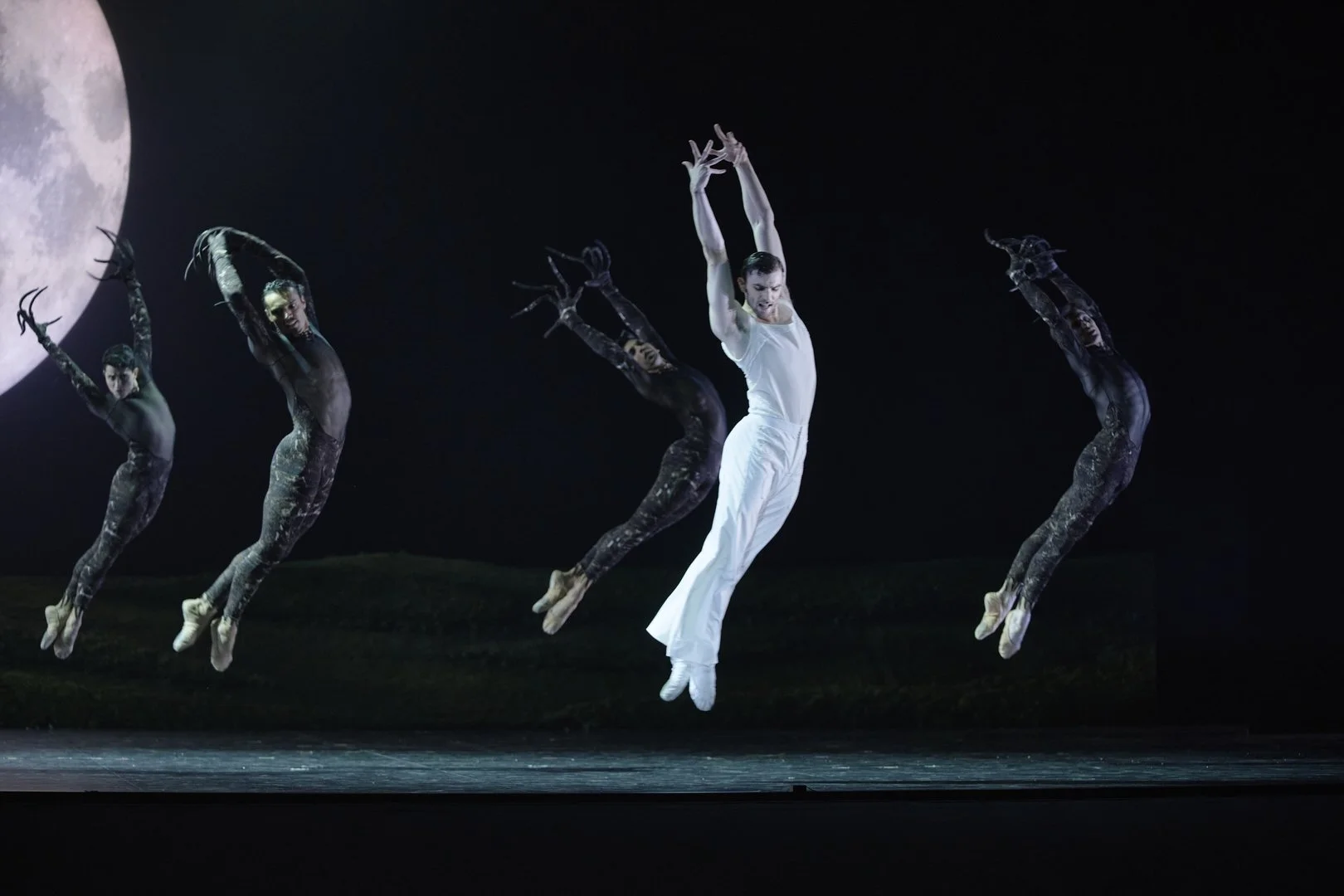
Photo: Sasha Onyshchenko
In his first collaboration with Les Grands Ballets Canadiens, the multi-hyphenate dancer, choreographer, and composer Guillaume Côté demonstrates a keen grasp of atmosphere. Working in a world of dreams and desire, he conjures genuinely magical moments in Midsummer Night Dreams. The Chicoutimi native became a renowned dancer and choreographer with Toronto's National Ballet of Canada before returning to Québec to pursue the next chapter of his artistic life.
Liberally adapting Shakespeare's A Midsummer Night's Dream, Côté places his magical forest at the centre of the action. Using a traditional ballet structure, he introduces the principal characters in the opening scenes, along with the full company in various roles as villagers and musicians. He bookends the work in much the same way, offering comfort to balletomanes who demand happy endings. But it's what happens in between that counts.
As Shakespeare famously wrote, "The course of true love never did run smooth." That is certainly the case here. While Côté focuses on the Athenian lovers Lysander and Hermia, Demetrius and Helena, and Ethan and Clara, as well as the fairy monarchs Oberon and Titania, he has streamlined Shakespeare’s cast, folding elements of Puck, the comic Bottom, and other figures into a smaller number of characters..
Under the glow of a full moon, Côté embraces a fluid sexuality, spotlighting both gay and lesbian desire. In abandoning a heteronormative reading, he echoes Shakespeare's own delight in gender play. In this topsy-turvy forest, gender-bending is everywhere. Over hill and dale, through bush and brier, to borrow from the Bard, the male cast members pursue one another with confident randiness, while Helena and Hermia seem comparatively restrained in their passions. Yet the continual eruption of erotic adventures begins to wear over time, and some judicious editing would strengthen Côté's staging of reality and illusion, making what should be riotous feel more incisive.
In the casting, Kiara Felder, as Maya, Puck’s replacement, is a supernatural shapeshifter, casting spells and stirring affections. Sadly, she is often underserved by Sonoyo Nishikawa's lighting design. Given Maya's supernatural centrality to the action, it is frustrating that one of the production's few Black performers is so frequently swallowed by the shadows of this otherwise lush and carefully rendered forest. Meanwhile, the key pairing of Maude Sabourin's bold Titania and Thomas Leprohon's understated Oberon generates little dramatic heat.
Michael Gianfresco's set is a verdant canopy of woodbine and exaggerated, overgrown vegetation. Within this dense forest, the lustful characters cavort repeatedly, nestling in its earthy shadows. One of the production's most striking nocturnal sequences features the corps de ballet embodying the woods themselves, their forearms becoming branches and their bodies trunks, enhanced by Rémi van Bochove's evocative costumes. For Oberon's fantasy sequence, set under the spell of a firefly-induced trance, designer Patrick Martel unveils an astonishing puppet in the form of a gigantic insect.
The Grands Ballets Orchestra is well served by conductor Dina Gilbert, who skillfully navigates passages from Mendelssohn's score along with flourishes including Johann Strauss’ The Blue Danube and Eric Satie's much-recycled Gymnopédies. Côté expands this musical landscape with works by Max Richter and Steve Reich, while Tommy Lunaire contributes a contemporary sound design that stretches, repeats, and transforms instrumental textures, creating an eerie, dreamlike atmosphere.
Toward the end of the play, Shakespeare has Puck ask, "If we shadows have offended." Côté's production never does. It remains an ambitious, visually sumptuous feast of images, but in the light of day its excesses become more apparent. At times overlong, the giddy revels of this midsummer night's dream are ultimately less enchanting than they might be.
Midsummer Night Dreams, Théâtre Wilfrid Pelletier, Place des Arts, Montréal, October 29-November 1, 2026
