Inhabiting the One
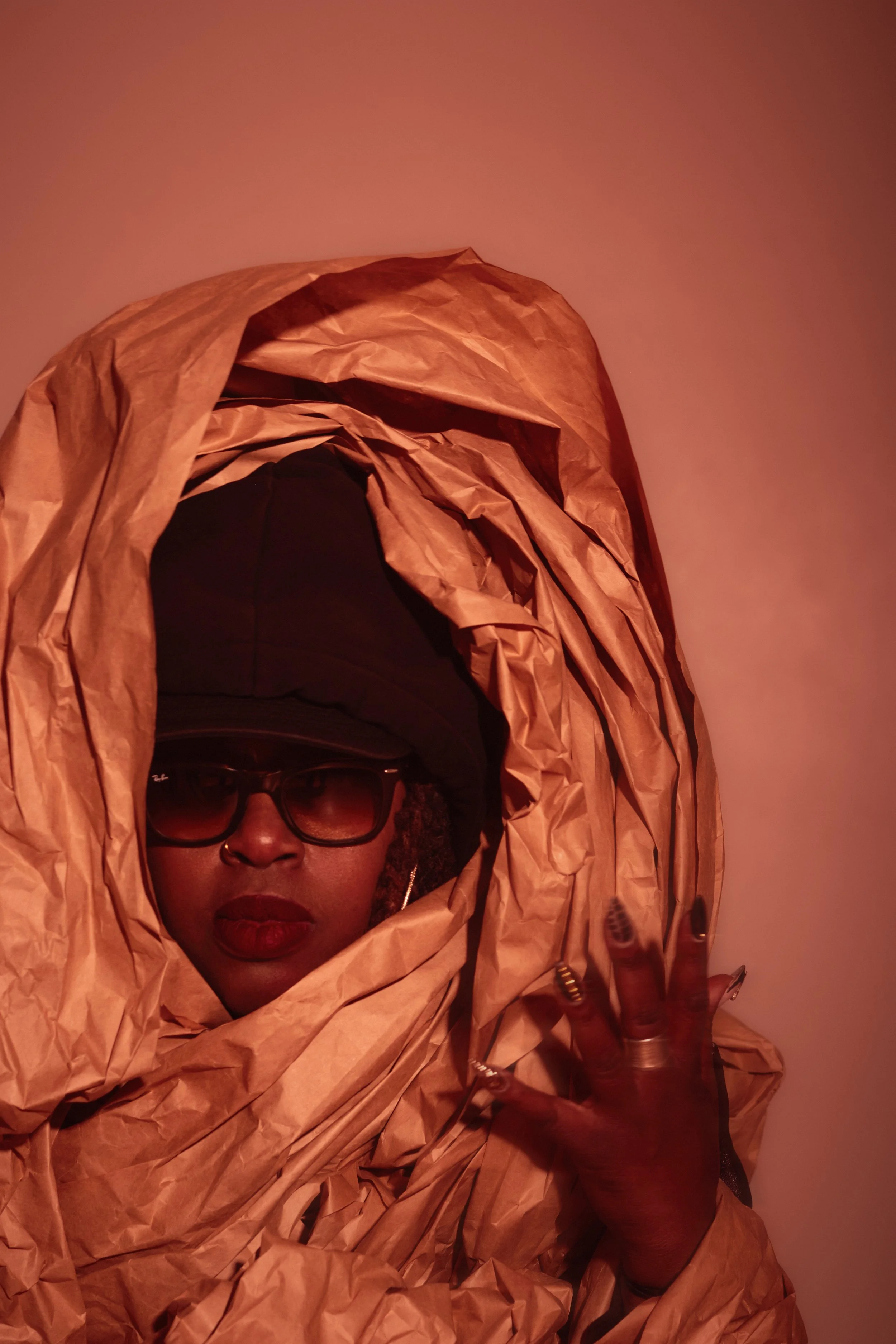
Photo: Muriel Truly Bien Aime
Alexandra “Spicey” Landé is laying it on the line in Mōnad, a work she created about two years ago through her company Ebnflōh, in collaboration with Montréal-based MC Jai Nitai Lotus. Originally commissioned by Danse-Cité, the work returns now as part of Agora de la danse’s 35th anniversary season.
As the audience filters into the venue’s intimate black-box theatre, the Montréal-based choreographer, teacher, and performer is already in a world of her own, shadow boxing and decked out in a distinctive all-black ensemble: hoodie, tights, cap emblazoned with “Backyard Worldwide,” sunglasses, and a cage-like tutu corset made of cloth. It is a stance that serves her well as she navigates the next seventy minutes. She occupies the space with confidence and power, projecting an air of certainty, as if asserting that she is exactly where she needs to be.
The opening sequence is energetic and improvisatory. Landé embodies fatigue, frustration, exasperation, and anger: the weight of racism, injustice, and the relentless pressures of everyday life. Here, she channels those charged emotions with intention, establishing the emotional terrain of the work. She eventually shifts into a state of exhaustion, settling into a rolling office chair, legs and arms wide, mouth open. While Mōnad is promoted as a solo, Landé and MC Lotus are hitting the beats together; in many ways, this is a duet.
This is also where the title begins to resonate. The term derives from the Greek monas, meaning “unit” or “oneness.” Landé’s sense of the One, from which multiplicity emerges, becomes a generative source point within a field of relationships and possibilities that unfolds throughout the performance. Mōnad negotiates identity, social space, and belonging through a shared world of interconnected perspectives and realities.
Landé is a leading figure in Quebec’s hip-hop dance community, but it had been a long time since she last appeared onstage. With more than two decades of experience, she founded the influential Bust A Move Festival in 2005 before launching Ebnflōh in 2015. Through the company, she has developed a choreographic practice that brings the aesthetics and values of hip-hop culture into dialogue with contemporary performance.
In the early stages of the work, we encounter what I can only describe as broken movement. Her arms are held aloft, bent at the elbows. At one point, head tilted upward and arms raised, she assumes a quizzical “What’s up?” stance. The amplified beat continues unabated, yet there is a stillness in Landé that stands in counterpoint to the head-bobbing appreciation of the music among the audience around me. It makes me sit up and watch more intently. There is a rippling visual effect as she weaves her hands and arms through the air in a kind of semaphore, her body becoming a conduit for the pounding music and its chant-like lyrics.
The lights dim and Landé moves toward a roll of brown craft paper. Slowly she begins wrapping herself, first enclosing her head and torso before working her way downward. She shuffles silently, cocooning herself within a private space that feels simultaneously familiar and unknowable to those of us seated in the theatre. The paper forms a hood, a kind of bundled armour. Her wordless progression in her swaddled state continues in near darkness. In that moment she appears as past, present, and future all at once: an innocent child in one instant, a burdened adult in the next. It’s as if the accumulating weight helps the grief to move. It’s a carefully choreographed sequence, advancing and retreating, unfolding according to a logic that remains elusive to the viewer.
The shedding of those layers is where Landé presses most directly against the collective experience, confronting the audience head-on with a shouted command: “Put your hands up!” At first the response is tentative, but she exhorts us and we answer more enthusiastically. Again she shouts, “Put your hands up!” repeating the phrase insistently. Whenever arms begin to drop, she challenges us again. She is relentless. It is also funny and absurd. My arms begin to burn.
“Put your arms up for Gaza.”
The crowd responds enthusiastically. She names other sites of global crisis: “Congo.” “Sudan.” When she reaches “Haiti,” the crowd erupts.
I am not entirely sure the audience grasps the depth of these distant and devastating realities. It always feels somewhat disconcerting when desensitized crowds cheer at crises in far-off places, as if profound suffering has become a trending topic detached from its context. What do many of us really know about the culpability, suffering, and violations occurring in places such as Goma? I am left wondering whether the urgent crises Landé invokes risk being obscured, even reduced. Yet the dissonance of that scene opens onto another register entirely.
Soon “Spicey” begins unravelling long reams of paper and tossing them into the audience. A sea of hands keeps the paper aloft, pushing it around and around the room. It is an oversaturated scene, impossible to ignore in its playfulness, and an effective strategy for disrupting our otherwise passive relationship to both performer and space. Minutes later, she invites audience members onto the floor to dance to a lovely, lilting Créole song. The pacing of this section is particularly compelling, offering a joyful respite for those overwhelmed by so much else.
There are objects that she uses very effectively, especially the craft paper. Other elements scattered throughout the space, including a ladder, a sewing machine, and a typewriter, are less fully integrated into the work's overall dramaturgy.
The MC remains ever present, a one-person Greek chorus shaping the atmosphere through constant commentary, musical interventions, and responsiveness to the unfolding moment. He plays harmonium and keyboard, spins music, and generally proves himself a true homme à tout faire. At one point, the lighting catches him swaying gently, rocking his body forward and back in a gesture that almost resembles worship.
In the final moments, ‘Spicey’ is seated, quiet and contained in a dimly lit space, biting into an apple. After so much movement, exhortation, and interaction, the image feels strikingly introspective. She seems to settle into a presence rather than perform for us, inhabiting a moment of stillness, taking care, before finally letting it go.
