Hors-d'oeuvre: The Urgency of Being Seen
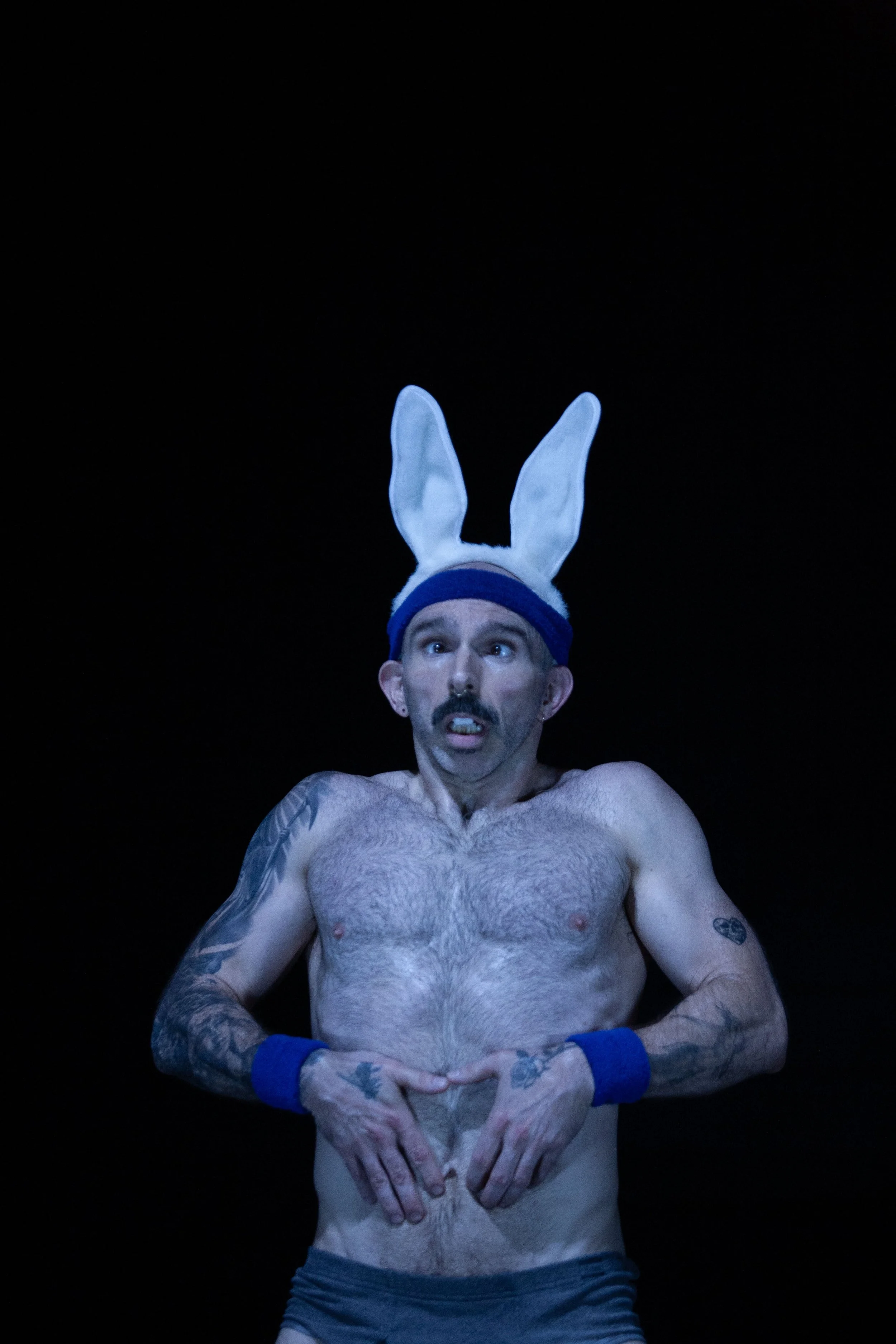
Photo: Orkhan Azim
There is something absolutely complex and almost undecipherable in dancer James Phillips' solo performance Hors-d'oeuvre, created with choreographer Catherine Gaudet.
It opens in an almost bare space, interrupted only by a circle of slim light panels mounted on stands (lighting by Hugo Dalphond). The stage is silent. Stuffed bunnies are scattered here and there, alongside a small toy horse perched on a black-clothed table. In an instant, Phillips' head juts into view, his mouth agape. Then he slowly sinks back behind the table. "Red Ford Radio" by U.S. Girls plays softly, almost indistinct, its drums beating steadily while the vocals implore, "I can't breathe in this red Ford anymore ... I'll do anything to get out, get out." At first, the words are difficult to discern; the music feels more like an echo from the past.
There is a playful, almost lulling quality to the repeated swing of Phillips' arms and the gentle lift of his heels. As the movements repeat, the vocals become increasingly present, disquieting, and addictive. It is as if Phillips is poised to spring into action. He seems held within a quiet cocoon, encircled by the ring of lights. We witness an awakening without ever gaining access to his inner world. As the performance unfolds, his movements become fiercer. Eventually they grow broad and expansive, carrying the sense that, if he could break free, he would. The movement is not harsh so much as urgent, suggesting an impulse to emerge from containment.
Dressed only in briefs, white socks, and a headband with bunny ears, Phillips presents a body that is both muscled and tattooed. There is something almost inhuman about him as he moves to the deliberate pulse of the music, swaying from side to side with a fixed, impassive gaze. His arms begin to rise in coordination with his heels lifting and falling. A subtle bounce emerges, creating a total engagement that reinforces the connection between performer and audience. The piece offers a remarkable fullness of intimate physical detail, even within its highly contained framework.
The simple melodic phrase gradually works its way into us. Heard since the opening moments, it now returns at full volume, the sound distorted and insistent. The pace of Phillips' movements accelerates; his face animates with a kind of crazed absurdity. Slashing at the air, he seems to demand recognition.
Phillips has appeared in several of Gaudet's group works in recent years, pieces that are notorious for testing the limits of dancers' endurance. Hors-d'oeuvre carries that same charged intensity through its repetition and finely nuanced movement vocabulary. What I find most gripping in the work is Phillips' persistent call: a demand not simply to perform, but to be seen.
