Between Trance and Spectacle
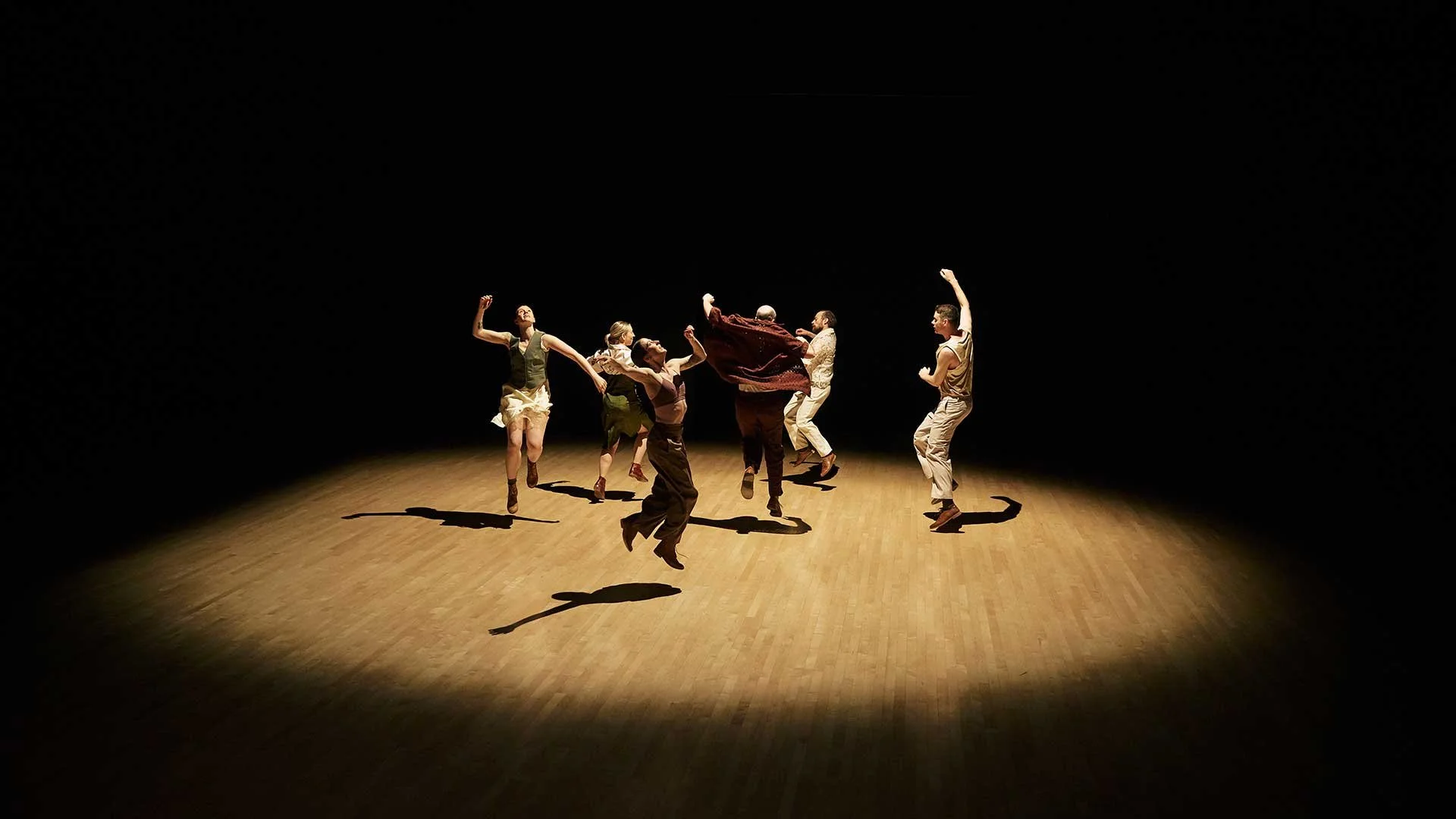
Photo: Vitor Munhoz
One thing that attracts me to the gigue form is that it is about community, as much as individuals. It is an extension of an oral and gestural tradition and an amalgam of percussive folk dance styles. The movement, the steps, are the essence of the gigueur's personality and physicality. These hoofers are constantly getting into the steps, bringing them to life. For its part, contemporary gigue has the power to bring diverse communities together.
Having trained with folk and percussive dance ensembles such as Mackinaw, Les Sortilèges, and Zogma, and through collaborations with artists who blend contemporary dance with traditional arts, Philippe Meunier and Ian Yaworski founded their own group, Les Archipels, in 2019. In the process, they have developed a contemporary reinterpretation of Quebec folklore. For several years now, they have been creating a gestural and rhythmic vocabulary that strips traditional Quebec gigue down to its essential elements while deconstructing folk dance through a contemporary aesthetic. In a world where contemporary dance can take many forms, they explore gigue not simply as sound, but through scale, rhythm, and dynamics, using the fullness of the body and incorporating the torso, arms, and floor work into a hybridized choreographic conception of space. The sound of a dancer's feet lightly striking the floor is not only intended to be audible, it is central to the total effect of the dancing. It is precise and nuanced, and their percussive rhythms grip the audience with remarkable force.
With their eight-member ensemble (Jonathan C. Rousseau, Rachel Carignan, Sébastien Chalumeau, Geneviève Lauzon, Andréa Niño, Olivier Rousseau, Liane Thériault, and Antoine Turmine), they have a mid-sized chorus that is visually and audibly compelling, and it is interesting that at the start of Les murs résonnent, Meunier and Yaworski choose to envelop the audience in a more poetically suggestive development of movement. Individual dancers circle with one arm extended, the body contained, the gaze internal, and yet deeply expressive. As the dance unfolds, it becomes clear that the movement is not an outlet for personal emotional expression. Rather, it is a process through which the individual self is shed, allowing the dancer to experience an absolute union with the universe that surrounds them. The texture created in those first minutes conveys an inner quietude and a restrained but palpable emotional register.
The fine interpreters operate on a slow burn, so it was jarring for me when they erupted into a manufactured crowd-pleasing mass movement mid-section, a loud, boisterous burst of performance. Judging by the reaction of some audience members on opening night, it was effective in bringing them on board, but for me it felt emotionally reductive, flattening much of the complexity that had been so carefully cultivated in the opening sections.
Where the piece succeeds is in its repeated footwork patterns, through which the dancers push past physical fatigue to find a meditative, almost trance-like rhythm. Quebec gigue is often described as incredibly grounded and downward-facing, with energy driven into the floorboards, movement guided from the hips down to generate a rich percussive dialogue between dancer and floor. Meunier and Yaworski have chosen a different approach, one that is more fluid and avoids a blunt, relentlessly rhythmic tapping style. They even lean toward ascent, creating an altered spiral of energy. That is what I found most engaging: watching these contemporary gigueurs use rhythmic endurance in a different register to expand the structured boundaries of the dance, inhabiting a state of joy without sacrificing emotional complexity.
